
How to Use GPL Themes on Client Sites Legally and Safely (2026)

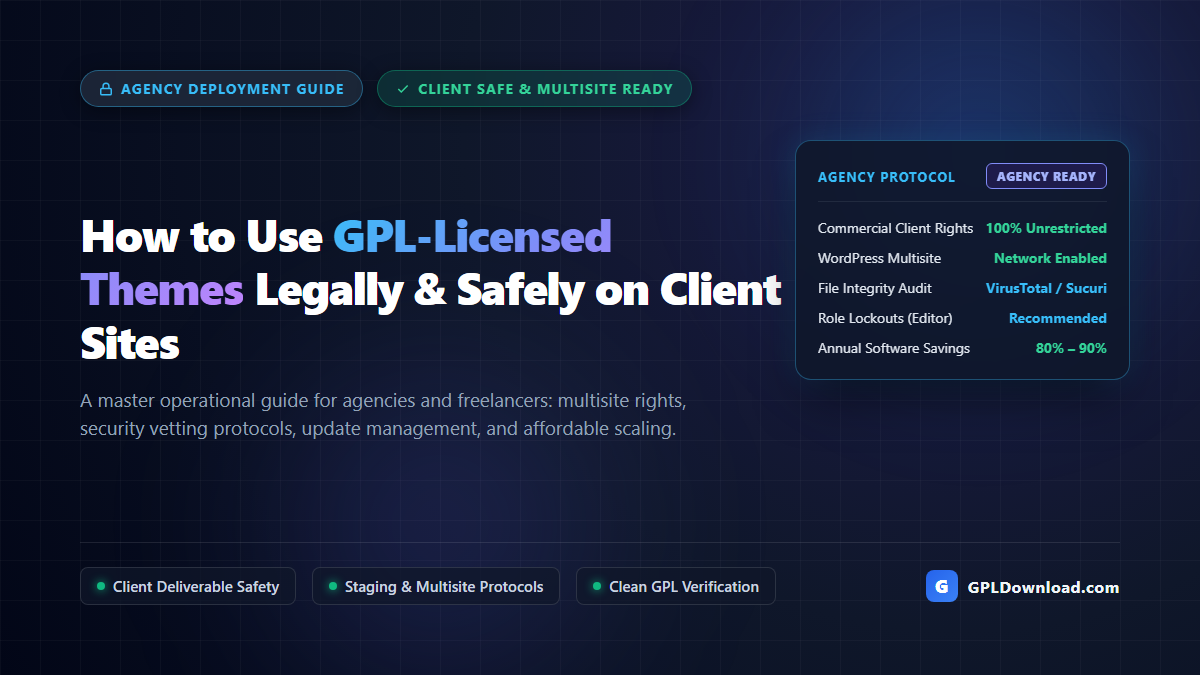
Key Takeaways for Agency Client Builds
- Full Commercial Rights: Under the GNU GPLv2+, you have the explicit legal right to use, customize, and deploy gpl license wordpress themes across unlimited client websites without paying individual site royalties.
- Multisite & Staging Flexibility: GPL software carries zero domain activation locks, making it ideal for local development, client staging environments, and WordPress Multisite networks.
- Update & Maintenance Hygiene: Because redistributed themes do not connect to private author update servers, agencies must implement a structured manual update or repository staging workflow to maintain security patches.
- Vetted Sourcing Protects Reputation: Never download themes from warez or file-sharing sites. Sourcing from verified marketplaces like GPL Download ensures clean, original vendor packages scanned by enterprise antivirus engines.
- Client Contract Clarity: Clear agency service agreements that distinguish custom design work from open-source theme foundations establish professional expectations and protect against licensing misunderstandings.
For freelance developers and digital agencies in India and worldwide, delivering high-performance WordPress websites to clients is a constant balancing act between design excellence and software overhead. When a local business or startup hires you to build an eCommerce store or corporate portal for ₹25,000 to ₹50,000 INR, spending $60 to $150 USD on individual proprietary theme licenses quickly destroys your project profitability.
To preserve margins and offer competitive project pricing, many developers turn to gpl license wordpress themes. However, deploying redistributed themes on paying client properties raises critical operational questions: Is it completely legal? How do you manage theme updates without client-facing license warnings? And how do you guarantee that third-party code will not expose your client to security vulnerabilities?
In this guide, we provide a complete operational blueprint for agencies and freelancers. We explore the legal framework governing WordPress theme licensing, evaluate the realities of multisite and client handovers, outline a robust security vetting protocol, and demonstrate how to scale your development pipeline safely and affordably.
In This Guide:
- What the GPL License Means for WordPress Themes
- Your Legal Rights on Client Deliverables: Commercial Use & White-Labeling
- Sample Contract Clause: Transparent Client Licensing Terms
- Deploying GPL Themes on WordPress Multisite Networks
- Managing Theme Updates Without Direct Author License Keys
- Security Risks: How to Vet Clean GPL Sources vs. Warez
- The Agency Client Handover Protocol: User Roles & Maintenance Retainers
- The 7-Step Agency Deployment Checklist
- GPL Download: A Trusted Open-Source Partner for Agencies
- Frequently Asked Questions
What the GPL License Means for WordPress Themes
The GNU General Public License (GPL) is the legal cornerstone of the entire WordPress project. When Automattic and the open-source community created WordPress, they chose the GPLv2 license to guarantee that software remains accessible and collaborative. Under this legal framework, any theme built to interface with WordPress PHP hooks and functions is recognized as a derivative work and must be licensed under the GPL.
For web agencies, this licensing structure establishes three essential operational freedoms:
- The Right to Use Without Domain Restrictions: You can install the software across an unlimited number of domains, subdomains, localhost environments, and client websites without incurring per-seat royalties.
- The Right to Modify and White-Label: You can alter PHP templates, strip out author branding, inject custom CSS grids, and adapt the theme to meet precise client design specifications.
- The Right to Redistribute: You have the lawful right to redistribute the software package as part of your agency services, enabling you to package themes into comprehensive client deliverables.
Unlike proprietary software models that lock code behind hardware IDs or domain activation tokens, the GPL prioritizes developer sovereignty. The code belongs to the user, not to an arbitrary activation server.
Your Legal Rights on Client Deliverables: Commercial Use & White-Labeling
A frequent concern among freelance developers is whether charging clients for a website built on a redistributed GPL theme violates commercial agreements. The legal answer is unequivocally clear: commercial deployment under the GPL is 100% lawful.
Freedom 0 of the Free Software Foundation’s charter explicitly states that users are permitted to run software for any purpose, including commercial business applications. When you bill a client for web design services, you are charging for your professional labor: wireframing, content integration, conversion optimization, responsive testing, and system architecture. The underlying theme functions as a foundation for your craft.
White-Labeling and Custom Child Themes
When delivering enterprise client projects, exposing external marketplace branding in the WordPress admin panel can confuse stakeholders or degrade your agency’s professional polish. Under the GPL, you have the full legal right to create a child theme, replace theme screenshots, and rebrand theme menus.
However, ethical agency practices require adhering to trademark law: while you can modify and rebrand the theme’s internal code, you should never claim trademark ownership over the original author’s registered corporate name or logo. Modifying the display label to your agency’s design framework while acknowledging open-source roots is standard industry practice.
Sample Contract Clause: Transparent Client Licensing Terms
Professional agencies protect their relationships with clients by maintaining complete transparency in their service contracts. When utilizing open-source GPL components, inserting a concise licensing disclosure clarifies expectations and eliminates confusion regarding future developer fees.
Here is an agency-tested contract clause you can adapt for your client onboarding agreements:
“The Website developed under this Agreement incorporates open-source software, frameworks, themes, and plugins licensed under the GNU General Public License (GPL). Client receives perpetual, non-exclusive rights to operate and modify all integrated code on the specified domain(s). Client acknowledges that initial project fees cover Agency’s configuration, design, integration, and development services. Direct 1-on-1 author technical support and automated vendor dashboard update keys are excluded from the initial build, but periodic updates, security audits, and compatibility patches are available under Agency’s active Maintenance & Retainer Agreement.”
By including this transparent clause, you establish that your agency is the trusted caretaker of the client’s infrastructure. Clients understand that maintenance is an active, valuable service provided by your agency rather than an automated mystery.
Deploying GPL Themes on WordPress Multisite Networks
WordPress Multisite (WPMU) is an essential architecture for agencies managing franchise networks, multi-location clinics, educational institutions, or real estate brokers. Under proprietary licensing models, vendors frequently charge steep enterprise surcharges—often $299 to $999 per year—simply to activate a theme across a network of subdomains.
Because GPL-licensed themes carry no artificial domain validation gates, they integrate naturally into Multisite networks:
- Network-Wide Activation: Super Administrators can network-enable a primary theme (such as Avada or Phlox Pro) from the primary dashboard, allowing all network sub-sites to utilize identical styling assets.
- Resource Efficiency: A single physical theme directory on the server serves dozens of distinct client domains, reducing server disk consumption and simplifying caching layers.
- Elimination of License Token Failures: Proprietary themes often fail in multisite environments when sub-sites mapped to external domain names cannot communicate with the author’s licensing API. GPL themes bypass this failure point entirely.
- Granular Child Theme Overrides: You can create lightweight child themes for individual sub-sites to load distinct CSS variables, logos, and accent palettes while sharing the parent theme’s compiled core engine.
| Deployment Dimension | Proprietary Single License | GPL Redistribution Model |
|---|---|---|
| Client Production Sites | 1 site per purchased key | Unlimited client properties |
| Staging & Local Dev | Often burns a production seat or requires manual whitelisting | Unrestricted staging subdomains & LocalWP |
| WordPress Multisite | Requires expensive agency/enterprise tier ($299+) | Native network enablement at zero extra cost |
| Annual Recurring Overhead | Compounds with every new client onboarded | Fixed, low subscription or one-time cost |
Managing Theme Updates Without Direct Author License Keys
The primary technical difference between buying directly from a developer versus sourcing from a GPL repository is the update mechanism. Original authors bundle license verification keys that connect to their private update servers, allowing one-click dashboard updates.
When you deploy a GPL theme, your client’s dashboard will not communicate with the author’s private server. For an agency, this is actually a significant operational advantage: automated updates pushed by authors frequently break production websites due to unannounced template changes, CSS conflicts, or database migrations.
The 4-Step Agency Update Protocol
To keep client websites secure, fast, and stable without relying on automated author pings, agencies should adopt this standard maintenance protocol:
- Monitor Vendor Release Logs: Keep track of version changelogs on GPL Download or developer blogs. Major security patches or WordPress core compatibility updates are your trigger to update.
- Download Clean Archives: Retrieve the latest verified version zip from your trusted GPL marketplace account.
- Test on Staging First: Upload the updated theme zip to a staging clone of your client site. Inspect responsive layouts, checkout funnels, and form submissions. Use migration utilities like All-in-One WP Migration Pro to clone environments effortlessly. Review our comparison of the best WordPress migration plugins for agencies.
- Deploy During Low-Traffic Windows: Once verified on staging, push the update to production during off-peak hours and purge server-side caches.
Security Risks: How to Vet Clean GPL Sources vs. Warez
The single greatest hazard in the open-source ecosystem is confusing legitimate GPL distribution with illegal “nulled” warez sites. Pirated warez operators distribute cracked files loaded with obfuscated malware, crypto-miners, and backdoors designed to hijack your server.
To protect your agency’s professional standing and keep client data airtight, apply these strict vetting criteria to every source you consider:
- Transparent Business Identity: Reputable platforms operate as registered commercial businesses with clear terms of service, active customer support channels, and transparent refund policies. Avoid anonymous file lockers, Telegram groups, and free download forums.
- Untouched, Original Vendor Packages: Legitimate distributors maintain active direct author subscriptions. They provide the authentic, unedited files exactly as delivered by the vendor without stripping code or inserting third-party scripts.
- Detection of Obfuscated Code: Clean GPL files contain readable, unencoded PHP code. Beware of any files containing
eval(gzinflate(base64_decode()))patterns or mysterious hex strings, which are universal indicators of malware tampering. - Multi-Engine Malware Auditing: Quality platforms scan all uploaded packages across enterprise security engines (such as VirusTotal, Sucuri, and Wordfence) before adding them to the public catalog.
- Money-Back Guarantees: Trustworthy repositories offer clear refund windows (such as GPL Download’s 7-day refund guarantee) so you can audit file integrity before committing.
The Agency Client Handover Protocol: User Roles & Maintenance Retainers
When concluding a website build, handing over full Administrator credentials to a non-technical client invites accidental breakages. Clients might see an update notification, install an incompatible plugin, or accidentally delete global theme styles.
1. Restrict Client Accounts to “Editor” Role
For standard day-to-day operations (publishing blog posts, editing product descriptions, or reviewing inquiries), clients only require the Editor role. Using role management plugins, you can grant clients full content control while restricting access to Theme Settings, Plugins, and Core updates.
2. Package Maintenance Retainers
Instead of leaving clients stranded without technical oversight, package ongoing maintenance into a monthly or quarterly retainer (e.g., ₹2,500 to ₹7,500/month). Your agency handles periodic theme updates, database backups, performance audits, and security monitoring. This creates steady recurring revenue for your agency while providing clients with complete operational peace of mind.
The 7-Step Agency Deployment Checklist
Before delivering any client website running on a GPL-licensed theme, run through this pre-flight quality assurance protocol:
- Download from a Verified GPL Source: Procure your theme zip from a trusted, authentic repository with documented author subscription pipelines.
- Perform Local File Audit: Extract the archive and verify that core PHP files contain no base64-encoded strings, external tracking URLs, or unauthorized eval() statements.
- Initialize on Staging: Test demo import scripts and page builder components on a staging subdomain or local environment.
- Create a Child Theme: Always place your custom CSS, template overrides, and PHP functions inside a dedicated child theme so future parent theme updates never overwrite customizations.
- Optimize Core Web Vitals: Combine your theme with a verified caching suite like W3 Total Cache Pro. Follow our comprehensive tutorial on how to speed up WordPress and pass Core Web Vitals.
- Audit Security with Wordfence or Sucuri: Run a complete server-level scan to verify zero warnings or modified core files.
- Create a Pre-Launch Baseline Backup: Capture a clean backup archive and document your update schedule in your client handover documentation.
GPL Download: A Trusted Open-Source Partner for Agencies
At GPL Download, we empower web design studios, freelancers, and growing businesses by providing an ethical, secure, and affordable software procurement pipeline:
- Direct Developer Memberships: We purchase authentic subscriptions from premier WordPress developers worldwide. You receive the exact, clean vendor files.
- Zero Tampering or “Nulling”: Every theme, plugin, and template kit is distributed in its original state, completely free from cracks, modifications, or malicious payloads.
- Unrestricted Multi-Site Deployment: Deploy downloaded software across unlimited client domains, client staging setups, and local sandbox environments.
- Expansive Theme Catalog: Explore popular business builders like Finbiz Consulting, corporate agency foundations, and niche eCommerce frameworks in our comprehensive WordPress themes collection.
- All-Access Pass for Agencies: Unlock our entire library of over 4,500 premium themes and plugins through the GPL Download All-Access Pass—backed by regular version updates and our 7-day money-back guarantee.
Frequently Asked Questions
Can my agency be sued for using a GPL theme on a client website?
No. The GNU General Public License is a legally binding international copyright license that explicitly permits commercial use, customization, and redistribution. Because WordPress derivative works are bound to the GPL, you are exercising your lawful open-source rights. However, ensure that you source clean, untampered files and avoid infringing on proprietary trademarks.
What happens if a client asks for the theme’s license key?
Explain transparently that WordPress themes operate under the open-source GPL license. The license key provided by original developers is only required for automated dashboard updates and 1-on-1 author ticket support. Reassure the client that your agency manages updates and testing as part of your maintenance agreement.
Are demo templates and dummy content included with GPL themes?
Most themes package demo data and starter sites directly within the theme zip or through companion plugins, which work flawlessly without license keys. However, themes that fetch demo content remotely from cloud servers requiring API authentication may require manual XML/WXR file importing.
Is it safe to update a GPL theme on an active client site?
Yes, provided you always test updates on a staging clone first. Never push parent theme updates directly to a live production server without verifying compatibility with active plugins and taking a full database backup.
What is the difference between a GPL theme and a nulled theme?
A GPL theme is authentic open-source code redistributed in its original, untouched state by a legitimate subscriber. A nulled theme is a cracked, modified file obtained from pirate sites that frequently contains hidden malware, backdoors, and tracking scripts. Read our deep analysis on what a GPL theme is and whether it is legal to use.
How do GPL themes compare to free repository themes?
Free repository themes provide baseline functionality but lock advanced styling, mega menus, and WooCommerce layouts behind paywalls. Premium GPL themes provide fully unlocked enterprise functionality without recurring subscription fees. For top free options, explore our guide on the best free WordPress themes for small businesses in India.
If you are new to the licence itself, start with what a GPL theme is and whether it is legal. Agencies often standardise on one builder for client work, such as Avada, JupiterX or Impreza; a GPL Download membership covers every theme you deploy.
Scale Your Agency with Sustainable, Open-Source Confidence
Leveraging GPL-licensed WordPress themes allows your digital agency to break free from predatory recurring licensing models, protect your client project margins, and maintain complete technical control over your web design deliverables. When paired with disciplined staging workflows and verified clean repositories, the GPL represents the ultimate competitive advantage for modern web professionals.
Discover thousands of authentic, verified themes and extensions on GPL Download today, and equip your agency with the tools to deliver world-class client results affordably.
Power Your Client Builds with Verified GPL Software
Access 4,500+ premium themes, builders, and eCommerce plugins with zero domain restrictions. Backed by clean code guarantees, regular updates, and our 7-day money-back policy.